Using the ASQ-3 with Bilingual Children: What to Know
How to accurately score the ASQ-3 Communication domain for bilingual toddlers, avoiding false positives while not missing real delays.
Quick Answer
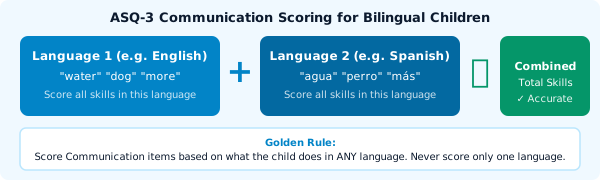
Bilingual children should be scored on the ASQ-3 Communication domain using skills across all languages combined. A word in Spanish and the same concept in English count as two words. Don't penalize dual-language learners by scoring only one language, this produces false positive delay results.
About 22% of U.S. children under 5 live in a home where a language other than English is spoken. For many of these children, language development happens across two languages simultaneously, and the way ASQ-3 Communication scoring is often applied creates an unnecessary problem.
This guide explains how to score ASQ-3 Communication accurately for bilingual children, what the research says about dual-language development, and how to tell the difference between typical bilingual variation and a real language delay.
The Core Issue: Single-Language Scoring
The ASQ-3 questionnaire was designed and normed primarily on monolingual English-speaking children. When providers or parents score Communication items based only on one language, typically English, bilingual children appear to have smaller vocabularies and fewer language skills than monolingual peers.
But this comparison is misleading. A 24-month-old who says "water" at daycare and "agua" at home has two words for the same concept. A child who follows instructions in Spanish but not in English understands the instruction. Scoring only English would dramatically underrepresent this child's actual language competence.
This is called vocabulary distribution across languages, bilingual children's words are spread between languages, not absent.
How to Score Communication for Bilingual Children
The correct approach: Score Communication items based on skills the child demonstrates in any or all of their languages combined.
For vocabulary items: Count a word if the child uses it in any language. "Dog," "perro," and "chien" are three instances of the concept "dog", but for vocabulary count purposes, count the concept once if they have it in one language, and more words if they label the same thing in multiple languages.
For following directions: If the child follows the instruction in any language it's given in, mark "Yes."
For social communication items (waving, pointing, showing): These are language-independent. Score what you observe regardless of language context.
Document this approach in your notes. If you're a provider scoring an ASQ-3 for a bilingual family, note "scored across [language 1] and [language 2]" in the questionnaire record. This matters if the record is reviewed later.
The Silent Period in New Language Learners
Sequential bilingual children, those who learn a second language after establishing a first, often go through a silent period when exposed to a new language. This is a normal phase where the child observes and processes before producing the new language. It can last weeks to months and is sometimes misinterpreted as a developmental delay or regression.
A child entering a new daycare or preschool where a different language is used may stop producing language in that new environment for several months. This is not a Communication delay, it's normal second-language acquisition.
The key distinction: during the silent period, the child should still be communicating in their home language. If language has decreased or stopped in all languages, that's a different concern.
When Bilingual Exposure Isn't the Explanation
Bilingual exposure explains some Communication score differences, not all delays. A true language delay exists when:
- The child's total vocabulary across all languages is below expectations for age (below ~50 words at 24 months total, not per language)
- No two-word combinations in any language by 24 months
- Receptive language is impaired, the child doesn't respond to directions in any language
- Social communication is atypical (absent pointing, reduced eye contact, limited joint attention)
- Language regression has occurred in all languages
If Communication domain concerns persist after scoring across all languages, a speech-language pathologist who is fluent in the family's home language, or who works with a professional interpreter, should conduct the evaluation. Evaluating bilingual children in English only produces unreliable results.
Research on Bilingual Language Development
Bilingual development is well-studied, and the research is consistent: dual language exposure does not cause language delays. Children learning two languages simultaneously meet key communicative milestones, first words, word combinations, complex sentences, at roughly the same ages as monolingual peers when vocabulary is assessed across both languages.
What does differ:
- Vocabulary per language: Each language typically has a smaller vocabulary than a monolingual peer's single language, but total vocabulary is comparable.
- Code-switching: Mixing languages within a sentence ("I want agua") is normal and does not indicate confusion or delay.
- Rate of language development: Some studies show bilingual toddlers produce slightly fewer words at 18–24 months but catch up to monolingual vocabulary levels by 3–4 years.
The ASQ-3 Communication domain items that are most susceptible to bilingual false positives are vocabulary-counting items. Receptive language items (following directions) and social communication items (pointing, joint attention) are more language-independent and should be scored based on observation.
Practical Scoring Guide for the Most Common Ages
12 months: "Says 'mama' and 'dada' with meaning", count this if the child says any caregiver label ("mama," "baba," "nana") in any language.
18 months: "Points to pictures in a book when named", test in the language the parent uses with the child at home. Don't test only in English if English isn't the primary home language.
24 months: "Uses words to ask for things", count this if the child requests in any language. "More," "mas," "encore," or pointing with vocalization all count.
36 months: "Strangers can understand most speech", for sequential bilinguals actively acquiring a second language, apply this only in the child's stronger language. It's normal for the newer language to be less intelligible.
Use our ASQ-3 calculator after scoring across both languages, the Communication domain score you enter should reflect combined language skills. See our guide on speech delays in toddlers for more on distinguishing typical bilingual development from a language delay that needs intervention. For a full breakdown of what Communication milestones look like at each age, see our developmental milestones guide.
Written by
ASQ Calculator Team
We build free, clinically accurate developmental screening tools for parents and pediatric providers.