Developmental Milestones by Age: 6 to 36 Months
A practical guide to what children typically do at 6, 12, 18, 24, and 36 months, with ASQ-3 scoring tips at each stage.
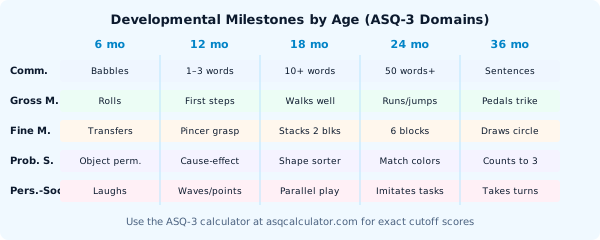
Quick Answer
Developmental milestones are ranges, not fixed deadlines. The ASQ-3 captures expectations at each age interval by comparing your child's scores to normative data from 15,000+ children. Here's what typical development looks like from 6 to 36 months.
Parents often search for precise answers: "Should my 14-month-old be walking?" "Is it normal that my 2-year-old doesn't have 50 words yet?" The honest answer is that development is a range, not a single point. What the ASQ-3 does, and what this guide will help you understand, is translate that range into actionable zones for each age interval.
6-Month Milestones
By 6 months, most babies are developing rapidly across all five ASQ-3 domains. Here's what's typical, along with the ASQ-3 scoring context for each area.
Communication: Babbling with consonants like "ma" and "ba." Turns toward voices. Responds to their name. ASQ-3 Communication scores at 6 months: refer cutoff around 18.3 points, meaning a child scoring under 18 out of 60 warrants evaluation.
Gross Motor: Rolls from back to front and front to back. Holds head steady when sitting supported. Reaches for objects with both hands. Gross Motor refer cutoff at 6 months: approximately 22.4 points.
Fine Motor: Transfers objects hand to hand. Brings hands to midline. Reaches and grabs with a raking grasp. Fine Motor refer cutoff: approximately 15.7 points.
Problem Solving: Explores objects by mouthing, shaking, and banging. Reaches for objects out of reach. Looks for partially hidden objects.
Personal-Social: Smiles spontaneously. Laughs and squeals. Recognizes and reaches for caregivers. Begins showing preference for familiar people.
At 6 months, ASQ-3 Communication and Gross Motor scores have the highest clinical significance, these domains track language groundwork and neurological development respectively. Use our ASQ-3 scoring tool to check your 6-month-old's domain scores against the published cutoffs.
12-Month Milestones
The 12-month visit is one of the most important well-child checkups. Language is emerging, motor development is often hitting major transitions, and social engagement should be rich.
Communication: Says "mama" and "dada" with meaning. Understands "no." Waves bye-bye. Points to objects of interest. One to two words beyond mama/dada is typical. The ASQ-3 Communication refer cutoff at 12 months is approximately 30.6 points.
Gross Motor: Pulls to standing. Cruises along furniture. Many children take first independent steps between 9 and 12 months, though walking by 15 months is normal. Gross Motor refer cutoff at 12 months: approximately 36.7 points.
Fine Motor: Pincer grasp (thumb and forefinger) is established. Self-feeds finger foods. Bangs objects together. Fine Motor refer cutoff: approximately 25.3 points.
Problem Solving: Puts objects in containers and takes them out. Looks for hidden toys. Imitates simple actions. Uses objects functionally, pretends to drink from a cup.
Personal-Social: Waves. Shows objects to caregivers. Plays peek-a-boo. May show stranger anxiety. Drinks from a cup with help.
If your 12-month-old isn't pointing, waving, or showing joint attention (looking at an object and then back at you), discuss this with your pediatrician. These social communication milestones are strong early indicators for ASD screening at the 18-month visit.
18-Month Milestones
At 18 months, language explodes for many children, but there's significant normal variation. The range for vocabulary spans from about 5 words to 50+ words, with most children landing around 10–25 words.
Communication: Says 5–20 words. Points to body parts when named. Follows simple one-step directions. The ASQ-3 Communication refer cutoff at 18 months is approximately 38.5 points.
Gross Motor: Walks well. Climbs onto furniture. Walks up stairs with help. Kicks a ball. Gross Motor refer cutoff: approximately 40.4 points.
Fine Motor: Stacks 2–4 blocks. Scribbles spontaneously. Turns pages in a board book. Fine Motor refer cutoff: approximately 30.9 points.
Problem Solving: Points to pictures in a book when named. Sorts shapes. Begins to use pretend play. Completes simple puzzles.
Personal-Social: Uses a spoon, though messy. Hugs stuffed animals. Helps with undressing. Points to indicate wants. Begins parallel play near other children.
The AAP recommends ASD screening with the M-CHAT-R/F at 18 months alongside general developmental screening. If you're using the ASQ-3, a "Refer" or "Monitor" result in Personal-Social combined with Communication should prompt a conversation about ASD evaluation. Read more about speech delays in toddlers if Communication is the area of concern.
24-Month Milestones
Two years is when language becomes the primary developmental focus. The "50-word, 2-word combination" benchmark is the most commonly cited, and most commonly misunderstood.
Communication: At least 50 words. Combining two words ("more milk," "daddy go"). Strangers can understand about 50% of speech. The ASQ-3 Communication refer cutoff at 24 months is approximately 44.3 points out of 60.
Gross Motor: Runs. Jumps with both feet. Kicks ball forward. Throws overhand. Walks up and down stairs. Gross Motor refer cutoff at 24 months: approximately 46.7 points.
Fine Motor: Stacks 6 blocks. Turns individual pages. Draws a vertical line. Fine Motor refer cutoff: approximately 37.3 points.
Problem Solving: Follows 2-step instructions. Points to pictures in a book. Sorts by shape and color. Completes a 3–4 piece puzzle.
Personal-Social: Uses spoon and fork. Washes hands with help. Plays alongside other children. Imitates adult behavior in play. Dresses self in simple clothing with help.
At 24 months, vocabulary below 50 words or no two-word combinations is a clinical red flag. Contact your pediatrician rather than waiting to see if the child "catches up." Research consistently shows that early language intervention is far more effective before age 3 than after.
36-Month Milestones
By 3 years, children's development spans a wide range of skills. Language should be clear enough for most strangers to understand.
Communication: At least 200 words. Uses 3-word sentences. Strangers understand most speech. Asks "what," "where," and "who" questions. The ASQ-3 Communication refer cutoff at 36 months is approximately 51.8 points.
Gross Motor: Climbs well. Pedals a tricycle. Walks up and down stairs alternating feet. Runs easily without falling. Gross Motor refer cutoff: approximately 54.5 points.
Fine Motor: Draws a circle. Puts on shoes (not necessarily correctly). Uses scissors with supervision. Builds towers of 8+ blocks. Fine Motor refer cutoff: approximately 44.1 points.
Problem Solving: Understands concepts like "same/different," "big/little," "more/less." Counts to 3 or more. Draws a person with 2–4 body parts. Can complete 4–6 piece puzzles.
Personal-Social: Dresses with minimal help. Takes turns in games. Plays pretend with dolls, animals, or people. Shows concern for crying friends.
Note that by 36 months, ASQ-3 cutoffs are quite high, scores must be close to the maximum of 60 to clear the monitoring zone. This reflects that most 3-year-olds are performing most skills most of the time. A single "No" answer can push a score below the cutoff.
Tips for Accurate Milestone Tracking
Score based on what you've actually observed, not what you think your child can do. If you haven't seen the skill in the last two weeks, score "Sometimes" rather than "Yes."
For bilingual children, count skills across both languages in the Communication domain. A child who says "agua" at home and "water" at daycare has two words, not one.
Keep a brief developmental log, a note in your phone works fine, recording new skills as you observe them. This makes questionnaire completion much more accurate and gives your pediatrician useful longitudinal information.
Run your current domain scores through our Ages & Stages Questionnaire calculator to compare against age-specific cutoffs. For context on what happens if scores fall in the referral range, read our guide on interpreting ASQ-3 results.
Written by
ASQ Calculator Team
We build free, clinically accurate developmental screening tools for parents and pediatric providers.