Speech Delay in Toddlers: When to Worry and What to Do
Understanding speech delay in toddlers, what counts as a delay, what causes it, and when watchful waiting becomes risky.
Quick Answer
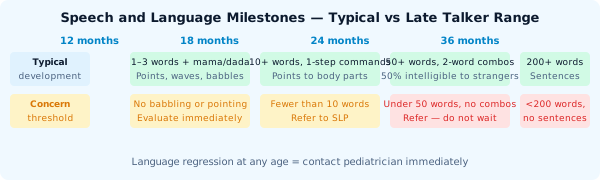
A "late talker" at 18–24 months has fewer than 10–50 words and no word combinations. Around 10–20% of toddlers are late talkers. About half catch up on their own. The other half don't, and early speech therapy significantly improves outcomes for both groups.
"He'll talk when he's ready." You've probably heard this from a well-meaning relative, maybe even a provider. Sometimes it's true. But language delay is also the most common developmental concern in early childhood, and distinguishing "he'll catch up" from "he needs help now" is exactly the purpose of tools like the ASQ-3 Communication domain.
This guide covers what speech delay is, what causes it, how to assess it, and, most importantly, when to stop waiting.
What Counts as a Speech Delay?
Speech and language are two different things, though we often use the terms interchangeably.
Speech refers to the physical production of sounds, articulation, fluency, voice. A child with a speech problem might have clear language development but be difficult to understand because of how they produce sounds.
Language refers to the system of words and rules for combining them, both understanding (receptive language) and expression (expressive language). Most early childhood delays involve language, not speech mechanics.
When pediatricians and speech-language pathologists talk about "speech delay" in toddlers, they usually mean expressive language delay, the child isn't producing expected words and combinations for their age.
Key benchmarks:
- 12 months: 1–3 words beyond mama/dada
- 15 months: 3–5 words
- 18 months: 10+ words; follow simple 1-step directions
- 24 months: 50+ words; 2-word combinations ("big truck," "more juice")
- 36 months: 200+ words; 3-word sentences; 75% intelligible to strangers
A child below these thresholds is not automatically delayed, these are medians and there's a distribution around each. But falling below these numbers at the listed ages is reason for evaluation, not for waiting.
The ASQ-3 Communication Domain
The ASQ-3 Communication domain specifically measures both expressive and receptive language through six questions scored at each age interval. Entering your child's Communication total into our ASQ-3 calculator immediately shows whether the score falls in the On Track, Monitor, or Refer zone for their age.
At 18 months, the Communication refer cutoff is approximately 38.5 points (out of 60). At 24 months, it's approximately 44.3 points. These are the score levels below which a full developmental evaluation is recommended.
What Causes Speech and Language Delays?
There's no single cause, and identifying it matters for choosing the right intervention approach.
Hearing loss is the first thing to rule out. Even mild conductive hearing loss, from recurrent ear infections, fluid behind the eardrum, can significantly impair language development because children learn to talk by hearing. A formal audiological evaluation is often the first referral after a Communication domain concern.
Late talkers with no other concerns: Some children, often boys, often with a family history of late talking, have delayed expressive language but typical receptive language, typical nonverbal communication (pointing, eye contact, social engagement), and no other developmental concerns. These children are often called "late talkers." About 50% of late talkers catch up without intervention by age 3. The other 50% don't, and they show better outcomes with early SLP intervention.
Developmental language disorder (DLD): Previously called specific language impairment, DLD is a persistent language disorder not explained by hearing loss, intellectual disability, or autism. It affects about 7% of children and often isn't identified until school age when reading difficulties emerge. Early identification and SLP intervention significantly improve long-term outcomes.
Autism spectrum disorder (ASD): Language delay, particularly delayed or absent babbling, absent pointing, and regression of words, is often the first concern that triggers ASD evaluation. ASD affects 1 in 36 children (CDC, 2023) and is associated with Communication and Personal-Social domain delays on the ASQ-3.
Bilingual exposure: Children learning two languages simultaneously may appear to have smaller vocabularies in each individual language while having an age-appropriate total vocabulary across both. This is vocabulary distribution, not delay. Score the ASQ-3 Communication domain by combining skills across all languages.
When Watchful Waiting Becomes Risky
"Wait and see" is appropriate in some situations. It's not appropriate for:
- A child who had words and has lost them. Language regression requires immediate evaluation.
- A 24-month-old with fewer than 10 words, regardless of how receptive language looks.
- A child who isn't pointing or making eye contact reliably by 14 months.
- A child whose Communication score falls in the "Refer" range on the ASQ-3.
The argument for early intervention is practical: the brain is most plastic in the first three years. A 22-month-old who starts speech therapy has 14 months of intensive support before age 3. A 26-month-old who starts at 3 has less. Both benefit, but the 22-month-old's trajectory is typically better.
IDEA Part C early intervention (EI) services are free for children under 3 with a qualifying developmental delay. You don't need a physician's referral, families can contact their state's EI program directly. Read our full guide on early intervention services for step-by-step information.
What a Speech-Language Pathology Evaluation Involves
An SLP evaluation for a toddler typically includes:
Case history: A parent interview covering the child's developmental and medical history, family history of language disorders, languages spoken at home, and specific parent concerns.
Standardized assessment: Tests like the Preschool Language Scales (PLS-5), Receptive and Expressive Emergent Language Test (REEL-4), or the Rosetti Infant-Toddler Language Scale provide norm-referenced scores for receptive and expressive language.
Play observation: The SLP observes the child at play, what they say, how they communicate nonverbally, how they respond to verbal input, which provides clinical information standardized tests may miss.
Hearing screen: Many SLP evaluations include a basic hearing screen or specifically recommend audiological evaluation.
The evaluation produces a report with standard scores, a clinical summary, and recommendations, typically whether therapy is recommended, at what frequency, and whether additional evaluations (e.g., ASD assessment) are needed.
Supporting Language Development at Home
Whether or not therapy is underway, these strategies are evidence-based and universally helpful:
Follow the child's lead. Comment on what your child is looking at or playing with rather than directing the activity. If they pick up a ball, say "ball" or "you found the ball" rather than asking "what's that?"
Expand language. Take what your child says and add one word. If they say "truck," you say "big truck" or "truck goes." This models the next step without demanding it.
Reduce questions. Constant questions ("What's that? What color is it? What do you want?") put communication pressure on a toddler. Narrate and comment instead.
Read books. Not by reading the text, but by talking about the pictures. "Look, a dog! The dog is running. You like dogs." Interactive shared reading expands vocabulary faster than passive reading.
Limit screens. The American Academy of Pediatrics recommends no screen time except video chat for children under 18 months, and limited, high-quality programming with co-viewing for ages 18–24 months. Passive screen exposure doesn't support language development the way interactive conversation does.
Use our ASQ-3 Communication scorer to track your child's Communication domain scores over time. For context on total developmental milestones at each age, see our guide on developmental milestones by age.
Written by
ASQ Calculator Team
We build free, clinically accurate developmental screening tools for parents and pediatric providers.