What Is Early Intervention? A Guide for Parents After a Referral
Everything parents need to know about IDEA Part C early intervention, eligibility, what to expect, and how to access free services after a developmental screening referral.
Quick Answer
Early intervention (EI) is a federally mandated program under IDEA Part C that provides free developmental evaluations and therapy services for children under 3 with delays or disabilities. Families can self-refer, no physician's order required. Services start faster when you call early.
Your child's ASQ-3 came back with a "Refer for Evaluation" result in one or more domains. Your pediatrician confirmed the concern. Now what? For families of children under 3, the most important next step is usually early intervention, and it's free.
What Is Early Intervention?
Early intervention (EI) is a federally funded program established under the Individuals with Disabilities Education Act (IDEA), Part C. Every state runs its own EI program, but federal law sets minimum standards: any child under 3 with a developmental delay or disability is entitled to a free evaluation and, if eligible, free therapy services.
"Free" is the actual word in the law. EI services cannot be denied based on family income. Services are provided in "natural environments", your home, a daycare center, wherever the child spends most of their time, rather than in a clinical setting.
Who Qualifies?
Eligibility criteria vary somewhat by state, but most programs qualify children in one of three categories:
Established condition: A diagnosed medical condition with a high likelihood of developmental delay (e.g., Down syndrome, cerebral palsy, severe prematurity). These children qualify automatically without proving a delay exists.
Developmental delay: A child who scores significantly below age expectations in one or more developmental domains on formal evaluation. States define the threshold differently, some require 25% delay, others use 1.5 or 2 standard deviations below the mean.
Informed clinical opinion: A professional's documented judgment that the child is at risk and likely to show delays without services. Some states include this as an eligibility pathway.
An ASQ-3 score in the "Refer" range doesn't automatically qualify a child for EI. It indicates that a full developmental evaluation is needed, and that evaluation determines eligibility.
How to Access Early Intervention
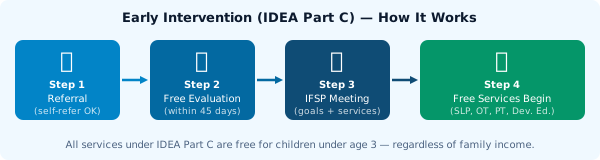
Step 1. Make the referral. In most states, families can self-refer to their EI program without going through a physician. Your pediatrician can refer you, but it's not required. Find your state's EI program by searching "[your state] early intervention Part C" or by contacting the Child Care Aware hotline at 1-800-424-2246.
Step 2. Evaluation. Within 45 days of referral (per federal law), an EI team will evaluate your child across all developmental domains. This evaluation is free and must be completed in your child's primary language. The team typically includes specialists from at least two disciplines, often a developmental specialist and a speech-language pathologist, or a physical therapist, depending on the concern.
Step 3. IFSP meeting. If the child qualifies, the team develops an Individualized Family Service Plan (IFSP). This is a written document describing the child's current functioning, family concerns, specific goals, which services will be provided, how often, and where. Parents are equal members of the IFSP team.
Step 4. Services begin. Services should start as soon as the IFSP is finalized. Common EI services include:
- Speech-language therapy (Communication domain delays)
- Physical therapy (Gross Motor delays)
- Occupational therapy (Fine Motor or sensory concerns)
- Developmental instruction (Problem Solving, learning strategies)
- Behavioral support (Personal-Social domain, ASD concerns)
- Family training and coaching (to generalize skills into daily routines)
Services occur at whatever frequency the team determines is needed to meet the child's goals, and they're provided in natural environments, your living room, not a clinic waiting room.
Why "Under 3" Matters
The "under 3" age cutoff isn't arbitrary. The first three years of life represent a period of extraordinary brain plasticity, neural connections form at a rate never seen again in development. Early intervention takes advantage of this window.
Research consistently shows that children who receive high-quality early intervention make more progress than those who start later. This isn't about pressure, it's about opportunity. A 24-month-old with a language delay who starts speech therapy now has 12 months of intensive support before the window narrows.
The National Early Childhood Technical Assistance Center (ECTA) documents outcomes data showing that the majority of children who receive EI services show measurable gains in development, and many exit the program having closed the gap with typically developing peers.
What Happens When a Child Turns 3?
Early intervention services end at a child's third birthday. If the child still has developmental needs at 3, they transition to IDEA Part B services through the local school district. This transition should begin at least 6 months before the third birthday, with a transition meeting between EI, the family, and school district representatives.
Part B services (ages 3–21) include special education preschool programs, related services (speech, OT, PT), and an Individualized Education Program (IEP) instead of an IFSP.
Many families are caught off guard by this transition. If your child is approaching 18–24 months and receiving EI services, ask your service coordinator to begin transition planning early.
Common Questions
"Does EI mean my child has a disability?" No. Many children receive EI services for delays that resolve fully before kindergarten. EI eligibility is based on current developmental status, not a permanent diagnosis.
"Will this affect my child's school records?" IFSP records are educational records under FERPA and are protected. Having received EI services doesn't appear in a child's permanent school record.
"What if I disagree with the eligibility decision?" You have the right to request an independent evaluation and to use the IDEA's dispute resolution procedures if you believe your child was wrongly found ineligible.
After you've used our ASQ-3 developmental scoring calculator and discussed results with your pediatrician, starting the EI referral process quickly is one of the most impactful things you can do. For a broader overview of warning signs that might prompt this process, see our list of developmental red flags. If speech is the primary concern, our guide on speech delays in toddlers covers the specific EI pathway for language.
Written by
ASQ Calculator Team
We build free, clinically accurate developmental screening tools for parents and pediatric providers.