How to Interpret ASQ-3 Scores: A Parent's Guide
Learn what ASQ-3 scores mean, On Track, Monitor Closely, and Refer, and what to do next after each result.
Quick Answer
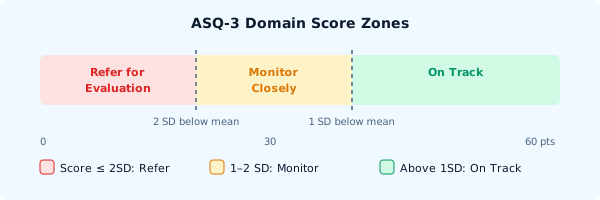
ASQ-3 scores fall into three zones per domain, On Track (above the monitoring cutoff), Monitor Closely (1–2 SD below the mean), and Refer for Evaluation (at or below 2 SD below the mean). A referral score means prompt contact with your pediatrician, not a diagnosis.
You've completed an Ages & Stages Questionnaire with your child. Now you're staring at five domain totals and wondering what they actually mean. This guide walks through every possible result, what causes it, what it tells you, and exactly what to do next.
Understanding the Three Result Zones
The ASQ-3 doesn't produce a single pass/fail score. Each of the five domains, Communication, Gross Motor, Fine Motor, Problem Solving, and Personal-Social, is scored independently and compared to age-specific cutoffs from a normative sample of over 15,000 children.
On Track
Your child's score exceeds the monitoring zone for this domain. Development appears typical for their age. "On Track" doesn't mean perfect. It means the score falls within the range expected for most children that age. You don't need to take any special action for this domain.
Continue completing the ASQ-3 at recommended intervals. The American Academy of Pediatrics (AAP) advises developmental screening at 9, 18, and 30 months, though many practices screen at every well-child visit from 2 months through 5 years.
Monitor Closely
The score lands in the monitoring zone, 1 to 2 standard deviations below the normative mean. This isn't an alarm. It means the domain warrants closer attention over the next few months.
What to do: Tell your child's pediatrician which domain landed here. They'll likely recommend re-screening in 2–3 months, not waiting until the next scheduled checkup. During that window, observe the specific skills measured in that domain. If development progresses, the score usually climbs into the "On Track" range on the follow-up screen. If it doesn't, that's useful clinical information.
One domain in the monitoring zone is common and often resolves on its own. Multiple domains in the monitoring zone, or one domain consistently in the monitor range across two screenings, deserves a conversation about a full developmental evaluation.
Refer for Evaluation
The score is at or below 2 standard deviations below the mean for this domain and age. The ASQ-3 manual recommends referring the child for a full developmental evaluation.
This is not a diagnosis. It's a signal to look more closely with better tools. Many children who score in the referral range turn out to have typical development when evaluated in depth. Screening tools are imperfect and produce some false positives. Others are identified as needing support, and early identification is the whole point.
Contact your child's pediatrician within the week. Don't wait for the next routine visit. Bring your completed questionnaire.
What Happens After a Refer Result
Your pediatrician will review the score, ask follow-up questions, and observe your child. From there, common next steps include:
For children under 3: Referral to your state's IDEA Part C early intervention (EI) program. Early intervention evaluates children at no cost to families and provides therapy services if the child qualifies. You don't need a physician's referral to contact your state's EI program, families can self-refer.
For children 3 and older: Referral for evaluation through the local school district (under IDEA Part B) or to a private developmental-behavioral pediatrician, speech-language pathologist (SLP), occupational therapist (OT), or physical therapist (PT), depending on the affected domain.
Communication domain refer: Likely referral to a speech-language pathologist.
Gross Motor refer: Likely referral to a physical therapist.
Fine Motor refer: Likely referral to an occupational therapist.
Problem Solving or Personal-Social refer: These often prompt referral to a developmental-behavioral pediatrician or psychologist for a broader assessment. If the Personal-Social domain is affected alongside Communication, the pediatrician may recommend ASD-specific evaluation using tools like the M-CHAT-R/F.
How to Use the Calculator for Multiple Screenings Over Time
Tracking scores across multiple intervals reveals developmental trajectories that single screenings miss. Use our ASQ-3 calculator after each completed questionnaire and note the results.
A child whose scores were solidly "On Track" at 12 months but slipped to "Monitor" at 18 months in one domain deserves attention, even though 18 months still technically shows "Monitor" rather than "Refer." Relative change matters.
Conversely, a child with a "Refer" result at 6 months who reaches "Monitor" at 9 months and "On Track" at 12 months has shown strong progress. That trajectory gives a different clinical picture than a child who stays in the "Refer" zone across three consecutive screenings.
Common Misconceptions About ASQ-3 Results
"A Refer score means my child has a developmental delay." No. It means their score fell below a statistical threshold on a screening questionnaire. Screening is not diagnosis. Published data show roughly 25–30% of children who score in the referral range are found to have typical development upon full developmental evaluation.
"If my child is bilingual, the Communication score will always be low." Not necessarily, but it can be affected. Parents who speak two languages should combine skills across both languages before scoring. If your child says a word in Spanish at home and in English at daycare, both count.
"On Track in all domains means I don't need to do anything." Even with strong ASQ-3 scores, ongoing developmental surveillance matters. Scores can change. Parent concern, even when scores look fine, should always be discussed with a provider.
When to Re-Screen
Regular use of the ASQ-3 developmental screening calculator makes it easy to track your child's scores across checkups without hunting for the paper scoring tables each time. See our complete guide to developmental milestones by age for a detailed breakdown of what to expect at 6, 12, 18, 24, and 36 months, and read about early intervention services if your child has received a referral.
Written by
ASQ Calculator Team
We build free, clinically accurate developmental screening tools for parents and pediatric providers.