10 Developmental Red Flags Every Parent Should Know
These 10 developmental red flags in children warrant immediate attention, not watchful waiting. Know when to call your pediatrician now.
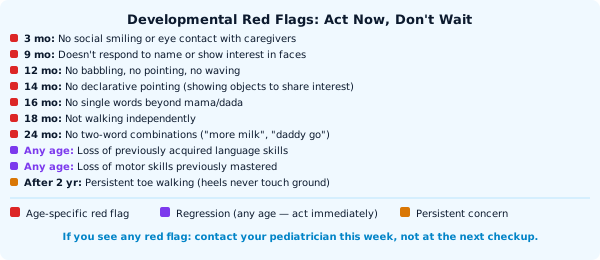
Quick Answer
Most developmental milestones have a wide normal range. These 10 red flags are different, they're absolute thresholds where the "wait and see" approach is not appropriate. If you see any of these, contact your child's pediatrician this week, not at the next scheduled checkup.
"Wait and see" is reasonable advice for many parenting concerns. It's not appropriate for developmental red flags. These are specific observations, missed milestones, loss of skills, or absent behaviors, that research consistently associates with conditions that respond best to early intervention. The earlier a concern is identified, the more effective support tends to be.
This list is not about normal variation. It's about thresholds. If your child shows any of these signs, the right move is a conversation with your pediatrician this week.
1. No Babbling by 12 Months
Babbling, sounds like "babababa" or "mamama", typically begins between 4 and 8 months and should be well established by 12 months. A 12-month-old who hasn't started using consonant-vowel combinations at all is showing a Communication red flag on the ASQ-3.
Don't confuse quiet temperament with absent babbling. Some babies are less vocal than others, but the absence of babbling sounds (not just speech) by 12 months deserves evaluation. This is often the earliest behavioral signal visible before other speech delays emerge.
2. No Single Words by 16 Months
Most children say their first real word, beyond "mama" and "dada", between 10 and 14 months. By 16 months, not having any intentional words (words used consistently to refer to things or people) is a red flag that warrants a speech-language pathology (SLP) referral.
"Intentional" is the key word. Saying "dada" randomly doesn't count. Saying "dada" when your partner walks in the door does.
3. No Two-Word Combinations by 24 Months
The "50 words and 2-word combinations by 24 months" benchmark is one of the most clinically significant in early childhood development. Two-word combinations, "more juice," "daddy go," "big dog", signal that language is developing as a rule-based system, not just as rote labels.
A 24-month-old who uses single words but hasn't started combining them should be evaluated by a speech-language pathologist regardless of vocabulary size. Use our ASQ-3 calculator to score the Communication domain, at 24 months, the refer cutoff is approximately 44.3 points.
4. Loss of Any Previously Acquired Language
This is a hard stop. If a child who was using words stops using them, at any age, contact your pediatrician that day. Regression of language skills, particularly around 18–24 months, is one of the most significant behavioral markers for autism spectrum disorder (ASD) and also occurs in rare but serious neurological conditions like Landau-Kleffner syndrome.
Don't wait to see if words come back. Don't assume it's because of a new sibling, travel, or illness unless a doctor has evaluated the regression.
5. No Pointing by 14 Months
Pointing, specifically declarative pointing (pointing to share interest, like pointing at a dog to say "look!"), is a milestone that develops between 9 and 14 months. It reflects joint attention: the ability to coordinate attention between an object and another person.
Joint attention is one of the most reliable early behavioral markers for autism when absent. A 14-month-old who doesn't point to show, request, or reference objects should be screened specifically for ASD at the next well-child visit, or sooner if you're concerned.
Imperative pointing (pointing to get something) develops slightly earlier than declarative pointing. Make sure your child is doing both.
6. Not Walking by 18 Months
Most children walk independently between 9 and 15 months. Walking by 18 months is considered the outer limit of the normal range. A child who isn't walking by 18 months should be evaluated for Gross Motor delay, even if other milestones appear typical.
On the ASQ-3, the Gross Motor refer cutoff at 18 months is approximately 40.4 points, and independent walking is one of the core 18-month items. Run the scores through our ages and stages questionnaire tool if you want to see exactly where your child's Gross Motor total stands.
7. Persistent Toe Walking After Age 2
Toe walking is common in early walkers and typically resolves on its own by 18–24 months. Persistent toe walking beyond age 2, where the child rarely if ever puts their heels down, may indicate tight heel cords, sensory processing differences, or, in some cases, cerebral palsy or autism. It deserves an assessment from a physical therapist.
8. No Eye Contact or Social Smiling by 3 Months
Social smiling in response to a caregiver's face emerges around 4–6 weeks and is well established by 3 months. A baby who hasn't smiled socially by 3 months, or who consistently avoids eye contact, is showing a Personal-Social red flag on the ASQ-3 for that age.
This is one of the earliest windows into social development. The ASQ-3 Personal-Social refer cutoff at 2 months is approximately 6.8 points, a very low threshold that reflects how fundamental these behaviors are at this age.
9. No Response to Their Name by 9 Months
A typically developing 9-month-old consistently turns or looks when their name is called in a normal voice (not shouted). Absent or inconsistent name response at this age is an early signal to watch carefully. It's one of the behavioral markers captured in ASD screening tools.
Make sure to rule out hearing loss first, hearing should be tested if name response is absent. But even after a normal hearing screen, inconsistent name response warrants close monitoring on the Personal-Social and Communication domains.
10. Loss of Any Motor Skill at Any Age
Like language regression, motor regression is never normal. If a child who was sitting independently stops doing so, if a child who was walking starts crawling again without a clear physical injury, or if muscle tone changes noticeably, contact your pediatrician immediately.
Motor regression can have neurological causes that are time-sensitive. It's a different concern from a child who simply progresses slowly.
What to Do If You See a Red Flag
Don't wait for the next scheduled well-child visit. Call your child's pediatrician and describe specifically what you're seeing. Bring a video if possible, a 30-second clip of your child attempting (or not doing) the skill in question is far more useful than a verbal description.
For children under 3, you can also contact your state's early intervention (EI) program directly. Under IDEA Part C, families can self-refer without a physician's order. EI programs provide free evaluation and services if the child qualifies.
For a structured look at your child's developmental status across all five domains, complete the ASQ-3 scoring using your questionnaire results. If you've received a referral result and aren't sure what comes next, our guide to early intervention services explains the process step by step.
Written by
ASQ Calculator Team
We build free, clinically accurate developmental screening tools for parents and pediatric providers.