Personal-Social Development: What the ASQ-3 Looks for and Why
The ASQ-3 Personal-Social domain tracks social-emotional development, how children engage with people and manage daily tasks. Here's what's normal, what's concerning, and what to do.
Quick Answer
The ASQ-3 Personal-Social domain measures how children interact with people and develop self-care skills. Low scores, especially combined with Communication domain concerns, warrant ASD-specific screening and prompt evaluation, since Personal-Social milestones are among the earliest behavioral markers for autism spectrum disorder.
Of all five ASQ-3 domains, Personal-Social is the one that generates the most parental anxiety, and rightly so. Social development isn't just about being friendly; it reflects how the brain is building the capacity for relationship, communication, and emotional regulation. Early patterns in this domain matter for long-term outcomes in ways that go far beyond toddlerhood.
This guide explains what the Personal-Social domain measures, what delays can mean, and how to support early social-emotional development.
What the Personal-Social Domain Measures
The Personal-Social domain captures two distinct but related areas of development:
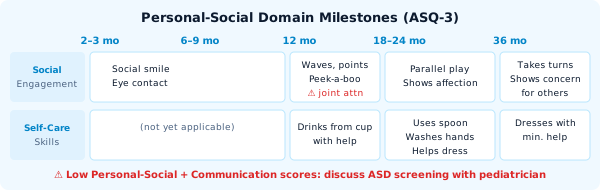
Social engagement: How a child seeks, initiates, and responds to social interaction with familiar and unfamiliar people. Eye contact, social smiling, sharing attention, playing near other children, seeking comfort from caregivers.
Self-care skills: The development of functional independence in daily routines, eating, dressing, toileting. These require both motor skills and the cognitive understanding of sequences and self-regulation.
ASQ-3 Personal-Social items at each age interval include a mix of both. The social engagement items are particularly sensitive clinically because atypical patterns in this area are among the earliest behavioral signals for autism spectrum disorder (ASD).
Personal-Social Milestones by Age
2 months: Social smile (smiling in response to a caregiver's face). Gazes at faces. Makes brief eye contact. ASQ-3 Personal-Social refer cutoff at 2 months: approximately 6.8 points, very low, because these behaviors are fundamental.
6 months: Laughs out loud. Smiles at familiar people. Reaches to be picked up. Explores face of caregivers. ASQ-3 Personal-Social refer cutoff at 6 months: approximately 17.2 points.
12 months: Plays social games (peek-a-boo). Waves bye-bye. Responds to name consistently. Shows objects to share interest (joint attention). Drinks from cup with help. Personal-Social refer cutoff at 12 months: approximately 28.5 points.
18 months: Plays near but not necessarily with other children (parallel play). Shows affection to familiar people. Uses a spoon. Points to show what they want. Begins pretend play. Personal-Social refer cutoff at 18 months: approximately 39.3 points.
24 months: Plays alongside other children. Imitates adult household activities. Puts on simple clothing. Washes and dries hands. Shows defiant behavior (normal at this age). Personal-Social refer cutoff at 24 months: approximately 48.3 points.
36 months: Takes turns in simple games. Shows concern for crying friends. Separates from caregivers more easily. Dresses and undresses with minimal help. Plays cooperatively with other children. Personal-Social refer cutoff at 36 months: approximately 52.2 points.
Use our ASQ-3 calculator to score your child's Personal-Social domain against the exact cutoffs for their age interval.
Why Personal-Social Matters for ASD Screening
The Personal-Social domain is particularly sensitive for autism spectrum disorder. Several of the domain's most clinically significant items are early behavioral markers that developmental researchers have identified as predictive of ASD:
Joint attention: Does the child look at something you point to? Do they point to show you something interesting? Do they look at your face to check your reaction? Joint attention, coordinating attention between a person and an object, typically emerges around 9–14 months. Its absence is one of the strongest early behavioral indicators of ASD.
Social smiling and engagement: A 3-month-old who doesn't smile socially, a 6-month-old who rarely makes eye contact, or a 12-month-old who doesn't respond reliably to their name, these are Personal-Social red flags that warrant close attention.
Functional play: Pretend play, which appears around 12–18 months, requires symbolic thinking and social understanding. Its absence or atypical quality (e.g., repetitive scripted play without variation) is clinically significant.
The AAP recommends ASD-specific screening with the M-CHAT-R/F at 18 and 24 months. These screenings complement the ASQ-3 Personal-Social domain, they don't replace it. A child who scores below the Personal-Social cutoff AND shows atypical patterns on the M-CHAT-R/F has a higher likelihood of ASD and should be prioritized for evaluation.
When Personal-Social Concerns Are Not ASD
Low Personal-Social scores don't automatically mean ASD. Other explanations include:
Temperament: Shy, slow-to-warm children may score lower on items involving stranger interaction or adaptation to new environments. This is different from the social engagement deficit seen in ASD.
Limited opportunities: A child who hasn't had much exposure to other children may score lower on peer interaction items. This reflects experience, not underlying delay.
Self-care delays: A child with fine motor or motor planning difficulties may fall behind on dressing and self-feeding items. This pulls the Personal-Social score down without indicating a social development problem per se.
Anxiety: Some toddlers develop significant separation anxiety or social anxiety. These aren't the same as the social communication differences in ASD, though they may also warrant professional support.
When a Personal-Social score falls in the monitoring or referral range, the pattern of specific items that are missed (social engagement items vs. self-care items vs. play items) helps guide the clinical interpretation.
Supporting Personal-Social Development
Be a responsive partner. The most powerful driver of early social development is a responsive caregiver, one who follows the child's attention, mirrors their expressions, and responds consistently to their bids for interaction. This isn't complicated; it's presence and attunement.
Narrate social experiences. Label emotions in yourself and in your child: "You look frustrated. This is hard." Emotional vocabulary builds emotional understanding over time.
Play social games. Peek-a-boo, patty-cake, and chase are explicitly about social engagement, turn-taking, and anticipation. They're intrinsically rewarding for babies and toddlers.
Encourage peer interaction. Arrange regular exposure to other children. Parallel play (playing near, not with) comes before cooperative play, and that's normal, but children need the opportunity.
Gradually extend self-care opportunities. Let toddlers help with dressing, give time and offer choice. Messy self-feeding matters more than neatness at 12–18 months.
Limit passive screen time. The AAP is clear that passive screen exposure doesn't support social-emotional development. Video chat with relatives counts as interactive; YouTube doesn't.
If Personal-Social scores concern you, especially alongside Communication domain results, discuss with your pediatrician and reference our guide to developmental red flags. For families whose children have received a referral result, our early intervention services guide explains what comes next. Score all five domains on our ASQ-3 developmental screening calculator for a complete picture.
Written by
ASQ Calculator Team
We build free, clinically accurate developmental screening tools for parents and pediatric providers.