Developmental Screening for Premature Babies: Adjusted Age Explained
How adjusted age works for premature infants on the ASQ-3, when to stop correcting, and what NICU graduates need from developmental screening.
Quick Answer
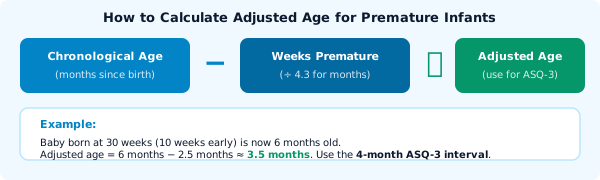
Adjusted age (corrected age) is chronological age minus weeks premature. A baby born 10 weeks early at 6 months chronological is developmentally closer to a 4-month-old. Use adjusted age when selecting the ASQ-3 interval for premature infants, typically through at least 24 months.
Premature infants, defined as babies born before 37 weeks gestation, are a distinct population for developmental screening. Comparing their milestones to full-term peers without adjusting for prematurity produces systematically inaccurate results, overidentifying delays in healthy preterm babies and potentially missing real concerns in others.
Understanding adjusted age isn't complicated, but getting it right is essential for meaningful ASQ-3 screening.
What Is Adjusted Age?
Chronological age is how long the baby has been outside the womb, calculated from their birth date.
Adjusted age (also called corrected age or corrected gestational age) accounts for prematurity by subtracting the weeks born early from the chronological age.
How to calculate adjusted age:
- Determine how many weeks premature the baby was born. A baby born at 30 weeks gestation was 10 weeks premature (40 weeks - 30 weeks = 10 weeks).
- Convert to months approximately: 10 weeks ≈ 2.5 months.
- Subtract from chronological age: if the baby is 6 months old chronologically, adjusted age is approximately 3.5 months.
For ASQ-3 screening, select the questionnaire interval closest to the adjusted age. In the example above, the 4-month interval would be used.
Our ASQ-3 calculator lets you select any age interval, simply enter your infant's adjusted age when choosing the interval, not their chronological age.
Why Adjusted Age Matters for the ASQ-3
The ASQ-3 normative data comes from a population of predominantly full-term babies. Comparing a 10-month-old born at 30 weeks (adjusted age 7.5 months) against the 10-month cutoffs would produce false positives for almost every domain, the baby simply hasn't had as much time for development to occur.
Using adjusted age corrects for this. The 10-month-old preterm baby screening at the 8-month interval is being compared to the right reference group, and results become clinically meaningful.
Studies of preterm infant screening specifically recommend adjusted age scoring on the ASQ-3 and have validated this approach. A 2015 study in the Journal of Developmental and Behavioral Pediatrics found that ASQ-3 screening with adjusted age produced sensitivity and specificity comparable to screening of full-term infants in NICU follow-up populations.
When to Stop Adjusting for Prematurity
This is where guidance varies somewhat by practice and protocol.
Standard recommendation: Continue using adjusted age through 24 months. Most developmental specialists consider 24 months the point at which the prematurity correction is no longer clinically significant for most children.
For significantly preterm infants (born before 28 weeks): Some NICU follow-up programs extend the adjustment to 36 months, particularly for gross motor and cognitive development.
Practical approach: At each well-child visit, ask your pediatrician explicitly whether to use chronological or adjusted age for screening. For NICU graduates, this question should be standard at every visit through at least age 2.
Developmental Risks in Premature Infants
Preterm birth doesn't inevitably cause developmental delays, but it does increase risk. The degree of risk correlates with gestational age at birth, birth weight, and whether complications occurred (e.g., intraventricular hemorrhage, necrotizing enterocolitis, severe respiratory disease, extended NICU stay).
Late preterm infants (34–36 weeks): Often discharged home quickly and appear healthy. However, late preterm infants have significantly higher rates of learning disabilities, attention difficulties, and mild developmental delays than full-term peers. They're sometimes under-screened because they look "fine."
Moderately preterm (32–34 weeks): Higher risk of motor delays, visual problems, and cognitive differences. Regular developmental surveillance is essential.
Very preterm (28–32 weeks) and extremely preterm (< 28 weeks): Highest risk across all domains. NICU follow-up programs typically screen these children formally every 3–6 months through age 3, then annually through school age.
ASQ-3 Domains Most Commonly Affected in Preterm Infants
Gross Motor delays are common in preterm infants, particularly those with periventricular leukomalacia (PVL) or other white matter injury. Delays in sitting, walking, and motor coordination often improve with physical therapy.
Fine Motor skills may lag, especially for very preterm infants. Handwriting and tool use difficulties may persist into school age.
Communication. Prematurity itself doesn't directly cause language delay, but chronic medical illness, extended NICU hospitalization (reducing parent-child interaction), and hearing loss (common in NICU graduates) all contribute to communication delays.
Problem Solving. Cognitive outcomes in preterm infants are highly variable. Some very preterm children have intellectual disabilities; many have normal intelligence with specific learning differences in math, executive function, or attention.
Personal-Social. Preterm infants often have regulatory difficulties (irritability, difficulty with transitions) in infancy that can affect social development. Some research associates prematurity with modestly higher rates of ASD and ADHD, though the mechanisms are complex.
NICU Follow-Up Programs
For infants born very preterm or with significant medical complications, NICU follow-up clinics provide detailed developmental monitoring outside of routine primary care. These programs typically include:
- Neurodevelopmental assessments using the Bayley Scales of Infant and Toddler Development (BSID-IV) at 6, 12, 18–24, and 36 months (corrected age)
- ASQ-3 screening at each visit
- Vision and hearing assessment
- Feeding and growth monitoring
- Referrals to physical therapy, occupational therapy, speech therapy, and early intervention as needed
If your preterm infant was discharged from the NICU with a follow-up program referral, attend those appointments even if your baby appears to be doing well. Sub-clinical delays that are invisible to casual observation become clear through standardized assessment.
Scoring Preterm Infants on the ASQ-3
When using our developmental screening calculator:
- Calculate adjusted age in months
- Select the ASQ-3 interval closest to the adjusted age
- Enter domain scores
- Interpret results against adjusted-age cutoffs
Document which interval you used and whether it was chronological or adjusted age. For NICU follow-up notes or early intervention referral paperwork, this distinction matters.
For more on what a referral result means and how to access services, see our guide to early intervention services. For a complete walkthrough of what typical development looks like at each age, our developmental milestones by age guide uses adjusted-age appropriate examples.
Written by
ASQ Calculator Team
We build free, clinically accurate developmental screening tools for parents and pediatric providers.