Problem Solving in Toddlers: What the ASQ-3 Measures and Why
The ASQ-3 Problem Solving domain measures cognitive development through play, here's what it tracks, what delays mean, and how to support early thinking skills.
Quick Answer
The ASQ-3 Problem Solving domain measures early cognitive development, object permanence, cause-and-effect understanding, sorting, counting, and pretend play. These aren't just "smart kid" skills; they're developmental milestones with specific expected ages, and delays here have implications for school readiness.
Of the five ASQ-3 domains, Problem Solving is the one parents most often misunderstand. Communication, Gross Motor, and Fine Motor have physical, observable skills that are easy to track. Problem Solving feels more abstract, and yet it captures something essential: how a child thinks.
This guide explains what the Problem Solving domain measures, what delays mean, and what parents can do to support early cognitive development.
What Does the Problem Solving Domain Measure?
The Problem Solving domain tracks cognitive milestones that developmental scientists consider precursors to formal learning. These aren't intelligence tests, they're markers of how the brain processes cause-and-effect relationships, memory, symbolic thinking, and reasoning.
Key concepts tracked across the ASQ-3 Problem Solving domain include:
Object permanence: understanding that an object continues to exist when out of sight. Emerges around 4–8 months. On early ASQ-3 intervals, items like "looks for dropped toy" or "searches for hidden toy" capture this.
Cause and effect: understanding that actions produce predictable results. "If I shake this rattle, it makes noise." Develops across 4–12 months.
Functional use of objects: using objects the way they're meant to be used (pretends to drink from cup, "reads" a book by looking at it). Develops 9–15 months.
Symbolic and pretend play: using one object to represent another ("this block is a phone"), creating scenarios with dolls or animals. Develops 12–24 months.
Sorting and categorizing: grouping objects by color, shape, or size. Develops 18–30 months.
Early numeracy: counting, understanding "more" and "less," comparing sizes. Develops 24–48 months.
Imitation: copying actions immediately and after a delay. Develops progressively from 3 months onward.
Problem Solving Milestones by Age
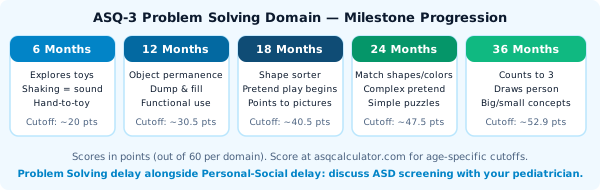
6 months: Explores toys by shaking, mouthing, and banging. Looks from hand to toy. Notices cause-and-effect (shaking produces sound). ASQ-3 Problem Solving refer cutoff at 6 months: approximately 20.0 points.
12 months: Searches for hidden object. Puts objects in container and dumps them. Imitates actions. Uses objects functionally. ASQ-3 Problem Solving refer cutoff at 12 months: approximately 30.5 points.
18 months: Completes simple shape sorter. Points to pictures in a book. Pretend play begins. Stacks rings in order. Problem Solving refer cutoff at 18 months: approximately 40.5 points.
24 months: Matches shapes and colors. Simple puzzles. Pretend play is more complex. Points to named body parts. Problem Solving refer cutoff at 24 months: approximately 47.5 points.
36 months: Draws a person with 2–4 body parts. Counts to 3. Sorts by color and shape. Understands concepts like big/small, same/different. Problem Solving refer cutoff at 36 months: approximately 52.9 points.
Enter your child's Problem Solving total into our ASQ-3 developmental calculator to see where it falls relative to the published cutoffs for their age.
What Problem Solving Delays Can Indicate
Global developmental delay: When Problem Solving delays appear alongside delays in other domains, this may indicate a global developmental delay, a broad developmental condition affecting multiple areas.
Intellectual disability: Persistent, significant delays across Problem Solving and other domains, confirmed through formal developmental testing, may indicate intellectual disability. Early identification matters a great deal for accessing appropriate educational support.
Autism spectrum disorder: Problem Solving delays in combination with Personal-Social delays can be an early indicator of ASD, particularly when symbolic play is absent or atypical.
Learning disabilities: Isolated Problem Solving delays, particularly in areas like categorization, sequencing, and early numeracy, can be early markers for specific learning disabilities, though formal diagnosis typically isn't possible until school age.
a single ASQ-3 Problem Solving score in the monitoring or referral range doesn't indicate any of these conditions. It indicates that full developmental evaluation is warranted.
How to Support Problem Solving Development at Home
The best support for cognitive development isn't worksheets or screens, it's interactive, object-based play with engaged caregivers. These activities target the specific skills the Problem Solving domain measures.
Hide and reveal games. At 4–8 months, practice object permanence by covering your face with your hands, then revealing it. At 9–12 months, hide a toy under a blanket and let the baby find it.
Cause-and-effect toys. Pop-up toys, light-up buttons, and simple mechanisms teach that actions have predictable results. These don't need to be expensive, a pot with a lid and a wooden spoon works.
Shape sorters and containers. The classic wooden shape sorter targets multiple cognitive skills at once: shape recognition, spatial reasoning, persistence.
Stacking and nesting. Stacking cups teach seriation (ordering by size). Nesting teaches spatial reasoning. Building and knocking down teaches cause-and-effect and builds problem-solving tolerance for "failure."
Pretend play. Follow your child's lead in make-believe. Pretend scenarios, feeding a doll, making a toy car "drive", are doing cognitive work even when they look like pure silliness.
Simple sorting. Sort laundry by color. Sort toys by type. Give your toddler a "job" that involves categorizing and organizing, it's cognitive training disguised as helping.
Counting everything. Count stairs going up, count grapes on the plate, count fingers and toes. Casual, repeated exposure to counting builds early numeracy before formal instruction begins.
Read together. Point to pictures and name them. Ask simple questions. Make predictions about what happens next. These activities build multiple cognitive skills simultaneously.
For a complete view of all five developmental domains, use our ASQ-3 scoring calculator after your next well-child visit questionnaire. See our guide to developmental milestones by age for what Problem Solving and other domains typically look like at 6, 12, 18, 24, and 36 months.
Written by
ASQ Calculator Team
We build free, clinically accurate developmental screening tools for parents and pediatric providers.