Fine Motor Skills in Toddlers: Activities to Build Dexterity
How fine motor skills develop in toddlers, what delays look like on the ASQ-3, and 15 evidence-based activities to build hand and finger strength at home.
Quick Answer
Fine motor skills, pinching, stacking, drawing, self-feeding, develop rapidly between 6 months and 3 years. The ASQ-3 Fine Motor domain tracks this progress. When scores fall below the refer cutoff, occupational therapy evaluation is the recommended next step. Play-based activities support fine motor development daily.
Fine motor skills, the small, precise movements of the hands and fingers, are foundational for nearly everything a child will do in school: writing, cutting, drawing, using a keyboard, and eventually reading (fine motor control supports early phonics activities involving pointing and tracking). They also underpin self-care: fastening buttons, using utensils, and managing personal hygiene.
The ASQ-3 Fine Motor domain captures whether these skills are developing on schedule. Here's what to expect, how to assess it, and how to support it.
Fine Motor Development: What to Expect
Fine motor development follows a predictable sequence from birth through the preschool years.
2–4 months: Hands are usually fisted. Opens hands when awake. Swipes at objects.
4–6 months: Grasping reflex gives way to voluntary reaching. Transfers objects hand to hand. Rakes at small objects. Puts everything in mouth (oral exploration is essential for sensory development).
6–9 months: Develops a raking grasp and begins moving toward a crude pincer (thumb + all fingers). Bangs objects together. Releases objects voluntarily, which is harder than grasping.
9–12 months: Pincer grasp (thumb + index finger) is developing. Picks up small objects intentionally. Pokes with index finger. Self-feeds finger foods. ASQ-3 Fine Motor refer cutoff at 12 months: approximately 25.3 points.
12–18 months: Stacks 2 blocks. Uses a spoon with some success. Scribbles spontaneously. Turns pages in board books. Puts shapes in holes. ASQ-3 Fine Motor refer cutoff at 18 months: approximately 30.9 points.
18–24 months: Stacks 6 blocks. Makes a vertical line. Turns individual pages. Completes simple shape puzzles. Removes clothing. Fine Motor refer cutoff at 24 months: approximately 37.3 points.
24–36 months: Draws a circle. Uses scissors with supervision. Strings large beads. Builds towers of 8+ blocks. Puts on shoes (not necessarily correctly). Fine Motor refer cutoff at 36 months: approximately 44.1 points.
Assessing Fine Motor Skills with the ASQ-3
The Fine Motor domain is one of the ASQ-3's most concrete, parents can usually observe the six domain items reliably in the home setting. Enter your child's Fine Motor total (0–60 points) into our ASQ-3 developmental screening calculator to compare against the published cutoff for their age.
A Fine Motor score in the "Refer" range at any age interval warrants an occupational therapy evaluation. OT assessment uses tools like the Peabody Developmental Motor Scales (PDMS-3) Fine Motor subscale or the Bayley Scales to provide a clearer picture of where delays exist and how significant they are.
When to Seek Occupational Therapy
Contact your pediatrician or early intervention program if:
- ASQ-3 Fine Motor score falls in the "Refer" range
- Your child isn't using a pincer grasp by 12 months
- Your child has no voluntary release of objects by 12 months
- Stacking 2 blocks by 15 months hasn't happened
- The child strongly avoids or seems distressed by messy play, textured objects, or sensory-motor activities (sensory avoidance can indicate sensory processing differences that OT addresses)
- Self-feeding with a spoon isn't happening at all by 18 months
15 Fine Motor Activities for Toddlers
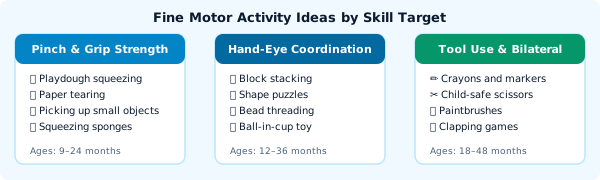
These activities are play-based, inexpensive, and developmentally appropriate. They're categorized by what they build.
Pinch and Grip Strength
1. Playdough play. Rolling, squishing, pinching, and poking playdough builds hand strength and finger differentiation. Add tools (plastic knives, cookie cutters) to increase complexity.
2. Tearing paper. Offer old magazines or junk mail. Tearing requires bilateral coordination and hand strength.
3. Picking up small objects. With supervision for safety, placing small pompoms, beans, or marbles into a narrow-mouth container builds pincer grip.
4. Squeezing sponges and bulb toys. Water play with sponges and squeeze toys builds grip strength with natural motivation.
Hand-Eye Coordination
5. Stacking blocks and nesting cups. Classic and effective. Increase challenge as the child progresses, small blocks before large, tall towers before wide.
6. Simple puzzles. Knob puzzles (single pieces with a handle) before interlocking pieces. Match complexity to the child's current level so it's challenging but not frustrating.
7. Bead threading. Large beads on a thick lace at 2–3 years. Develops bimanual coordination and hand-eye tracking.
8. Ball-in-cup toy. Catching a ball on a string with a cup develops hand-eye coordination and timing.
Tool Use
9. Crayons and markers. Offer thick crayons first (easier to grip), then progress to thinner ones. Don't require correct pencil grip, let it emerge naturally around age 3–4.
10. Child-safe scissors. Cutting practice starts with snipping (one cut across a strip of paper) before moving to cutting on lines. Spring-loaded scissors assist children with low grip strength.
11. Paintbrushes. Thick brushes, watercolor or finger paint, on large paper. Combines shoulder, wrist, and finger control.
Bilateral Coordination
12. Clapping and patty-cake. Bilateral rhythm activities build coordination between hands.
13. Pouring. Water play with small pitchers. Pouring from one container to another requires bimanual coordination and visual tracking.
14. Opening containers. Twist-off lids, snap containers, and zipper bags, functional practice with real-life objects.
15. Finger puppets and sock puppets. Promotes individual finger isolation and imaginative play simultaneously.
What Occupational Therapy Looks Like
OT evaluation and intervention for fine motor delays in toddlers is primarily play-based. A session might look like structured play at a table with specific materials chosen to target the child's goals, whether that's developing pincer grasp, tolerating messy textures, building bilateral coordination, or improving visual-motor integration (drawing).
Home programs are a core part of OT, therapists teach parents activities to practice between sessions, because therapy once a week isn't enough to drive development. The activities above are the kind of thing OTs typically recommend.
Early intervention OT (under age 3) is free through IDEA Part C. See our guide on early intervention services for how to access it. For a complete developmental picture, check your child's Fine Motor and all other domain scores with our ASQ-3 calculator. See also our guide to gross motor delays if motor concerns span both fine and gross motor domains.
Written by
ASQ Calculator Team
We build free, clinically accurate developmental screening tools for parents and pediatric providers.