Gross Motor Delays in Children: Signs, Causes, and Therapies
What gross motor delays look like at different ages, what causes them, and how physical therapy and early intervention can help.
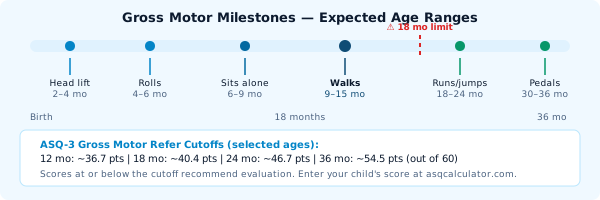
Quick Answer
Gross motor delays involve difficulty with large-muscle movements like rolling, sitting, walking, and jumping. A child not walking by 18 months, not running by 24 months, or showing consistently low ASQ-3 Gross Motor scores warrants evaluation by a physical therapist (PT).
Gross motor development, the progression of large-muscle control from early head lifting to running, jumping, and climbing, follows a broadly predictable sequence. When this sequence lags significantly, the ASQ-3 Gross Motor domain is often where parents and providers first notice.
This guide covers what gross motor delays look like at different ages, why they happen, and what parents can do.
What Is a Gross Motor Delay?
Gross motor development includes skills involving the trunk, arms, and legs in coordinated movement: rolling, sitting, crawling, standing, walking, running, jumping, kicking, and climbing. These skills develop in a relatively consistent order, though the exact timing varies.
A gross motor delay exists when a child's motor skills fall significantly below age expectations, specifically, when ASQ-3 Gross Motor scores fall at or below the age-specific cutoff (2 standard deviations below the mean), or when key motor milestones are absent at ages where they should be well established.
Use our ASQ-3 scoring calculator to see where your child's Gross Motor total falls relative to published cutoffs for their age interval.
Gross Motor Milestones by Age
2–4 months: Lifts head and chest during tummy time. Turns head side to side. Kicks legs when lying on back.
6 months: Rolls from back to front and front to back. Sits with support. Bears weight on legs when supported standing.
9 months: Sits independently without support. Pulls to stand. Creeps or crawls.
12 months: Stands alone briefly. Walks with one hand held. Many children take first independent steps. ASQ-3 Gross Motor refer cutoff at 12 months: approximately 36.7 points.
15 months: Walks independently. Can lower themselves from standing to sitting. Walks with some coordination.
18 months: Walks well. Climbs onto furniture. Walks up stairs with one hand held. Not walking by 18 months is a hard red flag, consult your pediatrician regardless of ASQ-3 score.
24 months: Runs. Kicks a ball forward. Jumps with both feet. Walks up and down stairs. ASQ-3 Gross Motor refer cutoff at 24 months: approximately 46.7 points.
36 months: Pedals a tricycle. Climbs with confidence. Walks up stairs alternating feet. Jumps forward.
What Causes Gross Motor Delays?
Hypotonia (low muscle tone): The most common cause of gross motor delays in early childhood. Low tone affects the muscles' baseline resistance, making movement feel effortful and reducing postural stability. Hypotonia can be idiopathic (no identified cause) or associated with Down syndrome, Prader-Willi syndrome, or other genetic conditions.
Neurological conditions: Cerebral palsy (CP) is the most common childhood motor disorder, caused by non-progressive brain injury occurring before, during, or shortly after birth. CP affects about 1 in 400 children. Prematurity significantly increases CP risk. Early physical therapy is central to CP management.
Muscle diseases (myopathies and muscular dystrophies): Duchenne muscular dystrophy, for example, often presents as gross motor regression in boys between 2–5 years, initially walking normally, then losing speed and strength. Unusual calf enlargement or frequent falling in an older toddler/preschooler warrants evaluation.
Developmental coordination disorder (DCD): A condition where motor planning and coordination are significantly below expectations without another motor or neurological diagnosis. Children with DCD often look clumsy, avoid physical activities, and have difficulty with both gross and fine motor tasks. DCD affects approximately 5–6% of school-age children.
Orthopedic issues: Hip dysplasia, torticollis, or foot abnormalities can affect motor development. These are often identified during routine newborn and well-child exams but can be missed.
Prematurity: Gross motor delays are common in preterm infants due to immature neurological development, hypotonia, and reduced intrauterine movement time. See our guide to developmental screening for premature babies.
The ASQ-3 Gross Motor Domain
The Gross Motor domain on the ASQ-3 contains six questions per age interval that capture expected large-muscle skills. Parents rate each item Yes, Sometimes, or Not Yet. A total below the refer cutoff for the age interval indicates a full motor evaluation is warranted.
At 18 months, for example, a Gross Motor total of 40 points or lower (out of 60) falls below the refer cutoff of approximately 40.4. A child scoring 41–51 is in the monitoring zone. Above 51 is On Track.
Document your child's Gross Motor score at each screening, tracking across multiple intervals reveals trends that a single score can't.
When to See a Physical Therapist
A physical therapist (PT) evaluates and treats gross motor delays. Referral is warranted when:
- ASQ-3 Gross Motor score falls in the "Refer" range
- Your child is not walking by 18 months
- Muscle tone appears unusually low or high
- Motor regression occurs (losing skills previously mastered)
- The child consistently falls, walks asymmetrically, or toe-walks after age 2
- Crawling pattern is unusual (bunny hopping, bottom-scooting exclusively)
PT evaluation includes standardized testing with tools like the Peabody Developmental Motor Scales (PDMS-3) or Bayley Motor Scale, direct observation of movement, and parent interview.
Physical Therapy Interventions
For infants and young toddlers: PT often involves coaching parents to position and handle the child in ways that encourage active movement. Tummy time strategies, facilitated transitions (supporting rolling or pull-to-stand), and sensory-motor play activities.
For walking-age children: PT focuses on strength and coordination training, balance activities, and, in cases of CP or significant hypotonia, orthotics (foot/ankle braces), adaptive equipment, and gait training.
Early intervention PT (under age 3, funded by IDEA Part C) is free and has strong evidence for improving motor outcomes. See our guide to early intervention services to understand how to access this. Children 3 and older access PT through school-based services or private therapy with insurance/private pay.
What Parents Can Do at Home
Maximize tummy time. Not just for infants, toddlers benefit from floor-level, ground-based play that builds trunk strength and coordination.
Encourage active play. Playgrounds, climbing structures, and unstructured outdoor time provide more motor challenge than most indoor activities.
Minimize strollers and carriers for children old enough to walk, let them walk wherever it's safe, even if it's slower.
Don't force milestones. "Practicing" walking with a child who isn't ready can reinforce poor movement patterns. Let PT guide the specific facilitation strategies.
Run your child's current Gross Motor score through our ASQ-3 developmental calculator. For a complete look at all five domains and what each means, see our guide on developmental milestones by age.
Written by
ASQ Calculator Team
We build free, clinically accurate developmental screening tools for parents and pediatric providers.