ASQ-3 vs Denver Developmental Screening: Key Differences
Comparing ASQ-3 and the Denver Developmental Screening Test, accuracy, administration, and which tool fits which setting.
Quick Answer
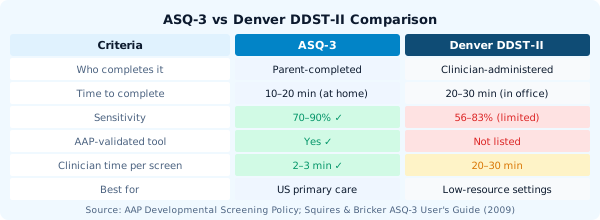
The ASQ-3 is a parent-completed questionnaire taking 10–20 minutes at home. The Denver Developmental Screening Test (DDST-II) is clinician-administered in 20–30 minutes using direct observation. Both screen the same age range, but the ASQ-3 has stronger published sensitivity data and costs less to administer at scale.
Two tools dominate developmental screening in pediatric primary care: the Ages & Stages Questionnaire, Third Edition (ASQ-3) and the Denver Developmental Screening Test, Second Edition (DDST-II, commonly called Denver II). Understanding the difference matters if you're a parent who's seen both tools used at different practices, or a clinician choosing between them for your setting.
What Is the Denver Developmental Screening Test?
The Denver Developmental Screening Test was first published in 1967 by Frankenburg and colleagues, with a major revision in 1992 producing the DDST-II. It remains widely used internationally and is often the first developmental screening tool pediatrics residents learn during training.
The DDST-II covers children from birth through 6 years. It's organized into four domains: Personal-Social, Fine Motor-Adaptive, Language, and Gross Motor. The clinician, typically a physician, nurse practitioner, or trained developmental specialist, presents tasks to the child directly, observes performance, and asks parents about skills they've observed at home. Each item is marked as "pass," "fail," "no opportunity," or "refusal."
An item is considered delayed if the child fails it while 90% of children their age pass it. A "suspect" result occurs if there are two or more caution flags or one or more delays.
What Is the ASQ-3?
The ASQ-3, developed by Jane Squires and Diane Bricker at the University of Oregon and published by Brookes Publishing in 2009, uses a different model: the parents complete the questionnaire themselves, usually at home before the visit. It covers 1 to 66 months across 21 age-specific intervals and five domains: Communication, Gross Motor, Fine Motor, Problem Solving, and Personal-Social.
Scoring is simple: Yes = 10 points, Sometimes = 5, Not Yet = 0. Domain totals are compared to cutoffs published in the ASQ-3 User's Guide, derived from a standardization sample of over 15,000 children. Each domain produces one of three results: On Track, Monitor Closely, or Refer for Evaluation.
You can score a completed questionnaire instantly using our ASQ-3 calculator.
Head-to-Head Comparison
Administration Time and Setting
Denver DDST-II: 20–30 minutes, clinician-administered, requires the child to be present and cooperative. Most items require direct performance (building blocks, drawing, following instructions). Difficult to complete with an upset, tired, or shy child. Performance can vary significantly based on the child's state on that day.
ASQ-3: 10–20 minutes for parents to complete at home before the appointment, 2–3 minutes for a trained staff member to score. Because parents observe skills over time rather than capturing a single moment, results are less affected by the child's behavior on any given day.
Sensitivity and Specificity
This is where the data diverge most clearly.
Published validity studies report ASQ-3 sensitivity (correctly identifying children with delays) of 70–90% and specificity (correctly identifying typically developing children) of 76–91% across age groups.
The Denver DDST-II has been criticized in the literature for lower sensitivity, with some studies reporting sensitivity in the 56–83% range, meaning it misses a meaningful proportion of children with developmental delays. Its specificity is generally high (85–94%), which reduces false positives but raises concerns about underidentification.
The AAP, which reviewed developmental screening tools in its 2006 policy statement (reaffirmed in subsequent updates), specifically notes that the Denver DDST-II does not meet criteria for a standardized developmental screening instrument due to limited sensitivity data and norming concerns. The ASQ-3 is included on the AAP's list of validated screening tools.
Cost
Denver DDST-II: Requires clinician time (15–30 minutes per child), testing materials (form board, yarn ball, blocks, etc.), and ongoing staff training. Per-screening cost in a busy practice runs $10–$30 in clinician time alone.
ASQ-3: Parent-completed, so clinician time is minimal. Score review takes 2–3 minutes. License fees for the ASQ-3 system are modest ($250–$500 per year for many practices). Per-screening cost is significantly lower.
Parent Engagement
The ASQ-3 model involves parents as active participants in screening, which has shown benefits beyond just time savings. Parents who complete the questionnaire become more aware of developmental milestones and more likely to raise concerns at visits. This aligns with the AAP's broader push for developmental surveillance, ongoing, collaborative monitoring, rather than isolated snapshots.
The Denver involves parents only for items the child "reportedly does" at home, which is a minority of items. Most scoring depends on clinician observation.
Global Use
Both tools are used internationally. The Denver DDST-II has been translated into dozens of languages and remains dominant in lower-resource settings where parent literacy may be a barrier. The ASQ-3 has been translated into over 20 languages and adapted for multiple cultural contexts, though it requires at least a 6th-grade reading level.
Which Tool Should Be Used?
For U.S. pediatric primary care settings implementing the AAP's recommendation for universal developmental screening at 9, 18, and 30 months, the ASQ-3 is the more commonly recommended tool based on validation data and practical scalability. It's one of the instruments specifically listed in AAP guidance.
For international settings or practices where parent literacy or language is a significant concern, the Denver DDST-II or a culturally adapted alternative may be more appropriate.
For individual screening at home, the ASQ-3 is the clear choice. The Denver isn't designed for self-administration. After completing your ASQ-3 questionnaire, calculate your child's domain scores here for instant results.
A Note on Combining Screenings
Neither tool is perfect. Some practices use both, the ASQ-3 as the primary screen and the Denver as a second-line confirmatory tool for borderline results. This approach increases identification rates but significantly increases time and cost.
The more practical alternative for borderline ASQ-3 results is re-screening in 2–3 months with the next age interval, as the ASQ-3 manual recommends for "Monitor Closely" scores. If scores remain in the monitoring or referral zone, a referral for full developmental evaluation provides far more diagnostic information than a second screening tool.
For more on what happens after a referral result, see our guide to early intervention services. For a rundown of warning signs that should prompt immediate conversation with your pediatrician, see our list of 10 developmental red flags.
Written by
ASQ Calculator Team
We build free, clinically accurate developmental screening tools for parents and pediatric providers.